It's quarter past three. Since the morning meeting you've been at your screen almost without a break, apart from a sandwich at your desk. Your neck is stiff, your eyes sting and you're reading the sentence you're writing for the third time. You'll go for a run tonight, you tell yourself. But at six you're stuck in traffic on the ring road, then dinner needs making, and the run slides to tomorrow.
That isn't a lack of willpower. It is a sign that your body is asking for something other than you think. Not necessarily more exercise, but more often something other than sitting.
Why sitting for long stretches is different from exercising too little
For a long time we assumed that enough exercise would cancel out the sitting. It isn't that simple. The World Health Organization recommends that adults do 150 to 300 minutes of moderate-intensity activity every week, but in the same guidelines it says separately that you should limit the time you spend sitting. Replacing sitting with movement of any intensity, light included, already brings benefits. And according to the WHO, people who sit a lot do well to aim above that minimum.
Part of the explanation is mechanical. Muscles that stay still for a long time use little energy and do less to keep blood moving through your legs. A posture held for hours loads the same structures over and over: the neck muscles carrying a head that has drifted forward, the lower back losing its natural curve in a slumped chair. No posture is wrong in itself. The problem is never leaving it.
Muscle and joint complaints are therefore anything but marginal. According to the European Agency for Safety and Health at Work (EU-OSHA), they are the most common work-related health problem in the EU: in 2015, roughly three in five workers across what were then the 28 member states reported such complaints. That figure covers every occupation, not just office work. But it shows how ordinary that stiff neck is.
1. Break up your sitting, ideally every half hour
The simplest habit is also the most effective: stand up regularly. There is no hard rule in minutes, but half an hour is a workable rhythm. You don't need to do exercises. Fetch water, walk to the printer, take a phone call standing or walking. In an open-plan office this takes some getting used to, because anyone who stands up gets noticed. At home it's the other way round: there's no colleague dragging you to the coffee machine, and you can sit from nine to twelve without noticing.
What helps is tying the standing up to something you already do. Stand up after every online meeting. Get on your feet for every phone call. A timer can work too, but many people dismiss it after a week. A habit attached to an existing moment lasts longer than one waiting for an alarm.
2. Give your eyes some distance
Your eyes are built to switch between near and far. In front of a screen they stay focused at the same short distance for hours, and you blink less. The American Academy of Ophthalmology points out that people normally blink about fifteen times a minute, but only five to seven times when using a screen. Blinking less means your tear film evaporates faster. You feel that as burning, dry or tired eyes.
The reassuring part, again according to the AAO: looking at a screen for a long time does not permanently damage your eyes. It's discomfort, not harm. A well-known rule of thumb is 20-20-20: every twenty minutes, look for twenty seconds at something about six metres away. Those exact numbers are a memory aid, not a scientific threshold. What matters is looking into the distance regularly and blinking deliberately a few times. A desk with a view out of a window helps more than you might think.
Watch your surroundings as well. A screen far brighter than the room, a window shining into your eyes or an air vent blowing straight at your face all make dry eyes worse.
3. Set up your workstation, at home too
A good workstation doesn't start with an expensive chair but with a few proportions. The top of your screen roughly at eye level, about an arm's length away. Feet flat on the floor or on a footrest, knees at roughly a right angle. Elbows close to your body and wrists straight as you type. On a laptop your neck is almost always bent, because the screen and keyboard can never both be at the right height. A separate mouse and keyboard, with the laptop raised on a stand or a pile of books, solves most of that.
Your employer has a part to play here too. Under the Belgian Code on Well-being at Work, the employer carries out a risk analysis of display screen workstations, trains and informs employees, and organises the work so that there are rest breaks. If your ordinary glasses aren't enough to see sharply at screen distance, the employer must in certain cases reimburse specific screen glasses. If you have doubts about your workstation, ask for the prevention adviser or the external prevention and protection service your employer is affiliated with. Ergonomic advice is part of their job, and it costs you nothing.
4. Move your neck and shoulders on purpose
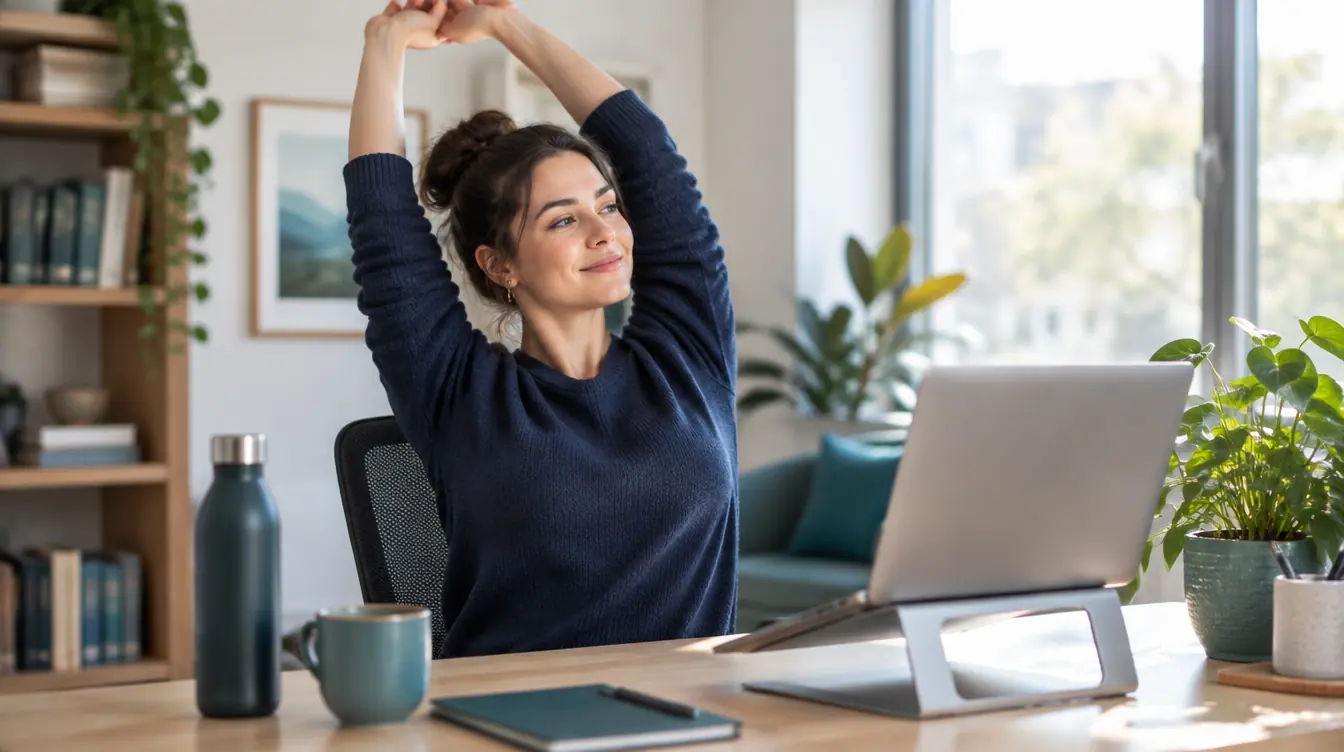
There are three simple movements you can do at your desk without anyone noticing. Let your ear drop gently towards your shoulder and hold for about fifteen seconds, then the other side. Roll your shoulders slowly backwards a few times. Sit up straight, link your hands behind your head and gently open your elbows so your chest opens.
Don't expect miracles. Stretching doesn't undo a posture you keep for the rest of the day, and no single exercise is magic. The value lies mainly in the variation: for a moment your muscles do something other than hold still. If a movement hurts, don't force it.
5. Make your lunch break a real break
The afternoon slump has several causes at once: your natural daily rhythm, a heavy lunch, too little to drink and plain tiredness after a morning of concentrated work. A sandwich over the keyboard while you read your emails is technically eating, but it isn't a break. Your mind gets no rest and your body doesn't move.
Try to eat away from your screen and, if you can, walk outside for ten minutes. Daylight, a little movement and a conversation about something other than work do more for your afternoon than another coffee. Keep a bottle of water within reach. In dry office air you often notice thirst late.
6. Treat your sleep as part of your working day
How you feel at three o'clock is partly decided the night before. Answering emails until midnight or scrolling in bed means starting the day with a deficit no ergonomic chair can make up. A regular bedtime, weekends included, helps your body clock. A cool, dark bedroom and a screen put away a while before sleep make it easier to drop off. Sunday evening is a well-known stumbling block: if you're already running through the whole week in your head, you tend to sleep worse.
When this isn't enough
Micro-habits are prevention and relief, not treatment. They help with the ordinary stiffness and tiredness of a desk job. They help little when the cause lies elsewhere: a workload that is structurally too high, a sleep problem that has dragged on for months, or pain with a medical cause.
See your GP if pain hasn't improved after a few weeks, if you feel tingling or loss of strength in your arms, hands or legs, if pain radiates into a leg, or if headaches keep coming back. Persistent tiredness also deserves a conversation with your GP, because very different things can lie behind it.
And sometimes that stiff neck at three o'clock is mostly a sign that you've been tense all day. If you notice that work pressure, worrying or poor sleep are the common thread, a conversation may help you more than a new chair. Many employers offer confidential support for this, for example through Meapy Health, where you can talk to a psychologist or coach.
This article is general information and does not replace medical advice.
Sources
- Bull FC, Al-Ansari SS, Biddle S et al., World Health Organization 2020 guidelines on physical activity and sedentary behaviour, British Journal of Sports Medicine (2020). https://pmc.ncbi.nlm.nih.gov/articles/PMC7719906/
- EU-OSHA, OSHwiki: Methodological review of available data on MSDs (accessed 2026). https://oshwiki.osha.europa.eu/en/themes/methodological-review-available-data-msds
- American Academy of Ophthalmology, Computers, Digital Devices, and Eye Strain (2024). https://www.aao.org/eye-health/tips-prevention/computer-usage
- FPS Employment, Labour and Social Dialogue, Beeldschermen (Display screens) (accessed 2026). https://werk.belgie.be/nl/themas/welzijn-op-het-werk/ergonomie-op-het-werk-en-de-preventie-van-msa/beeldschermen